

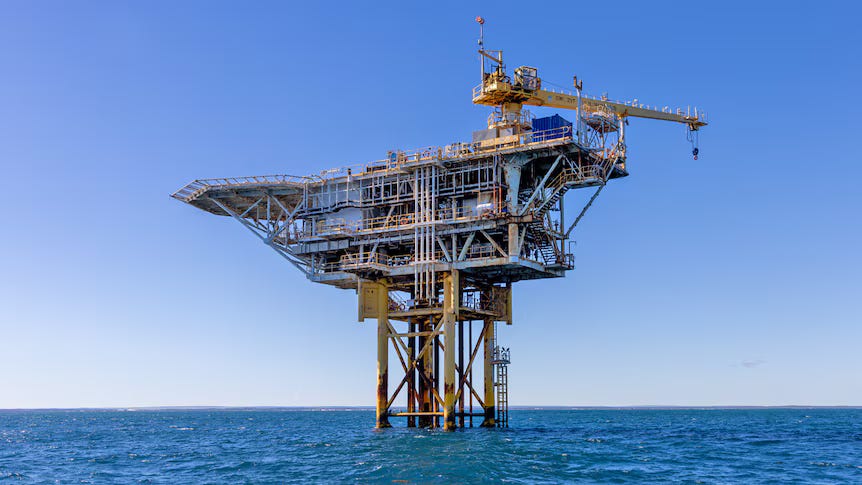
Off the coast of Dongara, in the Mid-West of Western Australia, stands the abandoned Cliff Head oil platform. In July, its owners, Joint Venture partners Pilot Energy and Triangle, both entered voluntary administration, leaving the platform stranded, the community concerned, and a $200 million unfunded decommissioning bill.
This is the second stranded asset left off the coast of Western Australia in the last six years, after the owners of the Northern Endeavour went into liquidation in 2020. That collapse left the Australian government with a $360 million decommissioning bill – which has now blown out to $1.5 billion and could reach as high as $2.5 billion.
There are a number of similarities to these cases; in both instances large companies sold their assets near the end of a project’s life, transferring all decommissioning liabilities and obligations to smaller operators who eventually folded; both cases could have been avoided; and both highlight the glaring holes in Australia’s decommissioning legislation.
After the Northern Endeavour, the government established an industry levy to recover the cost of decommissioning. The Department of Industry, Science and Resources (DISR) also announced legislative reforms. However, Cliff Head has shown us more needs to be done, and quickly.
The federal government has assured Australians that the clean up from Cliff Head will be industry – not tax-payer – funded. But Resources Minister Madeleine King signed a ministerial instrument in September which authorised the use of taxpayer funds to support the “operation, monitoring, inspection, maintenance and repair” of the Cliff Head oil platform. Again, Australians are paying for the failure of industry to take responsibility for their mess.
Offshore infrastructure isn’t benign once production ends; pipelines carry radioactive scale, wells leak hydrocarbons, steel corrodes, plastic breaks down and toxins affect the food chain. Aged, stranded assets pose economic, environmental and safety risks to Australia.
It is the owners responsibility to ensure the safe, timely and complete clean up of their projects. With $60 billion worth of offshore decommissioning required in the coming decades, Australia needs legislation that ensures this takes place.
Issues with our current legislation
Our current legislation allows decommissioning planning to be delayed and unfunded. The government has limited transparency of decommissioning plans, and a limited ability to intervene, weakening the regulator’s capacity to prevent the worst-case scenarios we’re seeing.
At no point in a project’s life does a company need to set aside funds or provide financial assurances or bonds for decommissioning. This was recently confirmed through a Federal Court challenge, which found Australia’s offshore oil and gas regulator, NOPSEMA, was not legally required to be satisfied that a proponent has the financial capacity to decommission its infrastructure.
Increasingly, companies are seeking “alternate end states” rather than completely removing their infrastructure. According to Keith Spence, Chair of Santos, repurposing infrastructure to develop Carbon Capture and Storage, “provides the opportunity to defer decommissioning expenditure at mature assets.” However, there are safety considerations associated with leaving end-of-life infrastructure in-situ or repurposing it for new projects. While some industry-backed research suggests minimal harm, independent long-term studies are scarce, and many of the dangers are still unknown.
In an industry focused on maximising profits, there is a recognised culture to delay decommissioning, underestimate costs, assume assets can be left in-situ rather than removed, and transfer assets and liabilities to other companies.
Unless our legislation enforces it, oil and gas companies remain financially disincentivised to uphold their decommissioning responsibilities.
Reforms Needed
The Australian government is currently trying to strengthen our offshore decommissioning legislation. Stakeholders across multiple sectors are involved in the consultation process, and all – bar the oil and gas industry itself – are largely calling for the same reforms:
● Transparency - Oil and gas companies must be required to report on their liabilities project-by-project, to increase accountability and improve accuracy on cost estimates for decommissioning.
● Financial Assurances - Oil and gas companies must be legally required to set aside dedicated clean-up funds and upfront security. Bonds must be secured in third-party accounts and regularly, independently, reassessed. Reforms must ensure industry pays for decommissioning activities, and trailing liability provisions must prevent future costs becoming the responsibility of the government or the Australian community.
● Safety and Compliance - Decommissioning must be carried out safely by a qualified workforce and it must protect the marine environment, with full removal of infrastructure as the base-case expectation. Compliance must be enforced with clear frameworks and consequences.
● Planning - Decommissioning plans should be built into a project’s initial design. This is a requirement for all onshore mining activities, the offshore industry should be no different.
Further, Australia’s Petroleum Resources Rent Tax (PRRT) allows for taxpayer funded rebates to cover decommissioning costs. This also needs reform.
Why this can’t wait
According to the Centre of Decommissioning Australia (CODA), approximately 5.7 million tonnes of offshore oil and gas infrastructure must be removed from our oceans, and 89% of it is in Western Australia. While the decommissioning timeline extends to 2060 and beyond, 50% of that infrastructure must be decommissioned before 2030, and nearly 75% by 2040. The most urgent phase is now.
Decommissioning is one of the most significant industrial and environmental tasks of our time, but also one of the most promising. The government must act decisively.
The Opportunity
Most of this infrastructure is high-value materials (60% steel, 25% concrete) that can be recovered and recycled. With forward planning from a project’s commencement, as well as dedicated funds set aside for decommissioning, and end-to-end supply chain mapping, decommissioning is a huge opportunity for Australia, particularly here in WA.
The reuse and repurposing of materials from decommissioning could supply valuable resources to existing and emerging Australian industries, create thousands of secure domestic jobs and support worker justice in the energy transition. A WA Decommissioning Hub could support local supply chains, recover valuable materials for a circular economy and industries like green steel, and lay the groundwork for clean energy pathways to offshore wind and renewables.
This conversation is happening at the same time as the industry is still pushing to expand, with huge new proposals such as Browse and Bedout in the pipeline. But to date the sector has failed to demonstrate how they will manage the spectre of existing infrastructure already lying off our coast.
The federal government has the reasons, the risk and the responsibility to introduce strong legislative reforms that guarantee companies fulfil their decommissioning requirements and safeguard the Australian economy, environment and industry. With more fossil fuel companies already flagged at risk of being unable to meet their decommissioning costs, these are reforms we need to get right, right now.
Excellent article Greta, these marine mining legacies are a growing threat to marine health, and are a dangerous and financial liability for future generations. It seems politicians and regulators have learned nothing from Australia's experience with terrestrial mining which shares the same problems.
Typical privatisation for the tax payer and social welfare for the big corporates who walk away scott free while we are the philanthropists that pay for them to get what they want they get the profits and we get the bill, thanks to politicians that are in bed with corporates.